Publications

Invasion patterns in marine species

May 11th, 2010  |  Published in General ecology, Marine ecology, Publications

Frederic Mineur, Andrew J. Davies, Christine Maggs, Marc Verlaque and Mark Johnson

The invasive alga Sargassum muticum

Not all introduced (invasive) species in a region will spread from a single point of introduction. Long-distance dispersal or further introductions can obscure the pattern of spread, but the regional importance of such processes is difficult to gauge. These difficulties are further compounded when information on the multiple scale process of invasive species range expansion is reduced to one-dimensional estimates of spread (e.g. km yr−1). We therefore compared the results of two different metrics of range expansion: maximum linear rate of spread and accumulation of occupied grid squares (50 × 50 km) over time. An analysis of records for 54 species of introduced marine macrophytes in the Mediterranean and northeast Atlantic revealed cases where the invasion process was probably missed (e.g. Atlantic Bonnemaisonia hamifera) and suggested cases of secondary introductions or erratic jump dispersal (Dasysiphonia sp. and Womersleyella setacea). A majority of species analysed showed evidence for an accumulation of invaded sites without a clear invasion front. Estimates of spread rate are increasing for more recent introductions. The increase is greater than can be accounted for by temporally varying search effort and implies a historical increase in vector efficiency and/or a decreased resistance of native communities to invasion.

In press in the journal, Proceedings of the Royal Society Series B: Biological Sciences.

Full citation

Mineur F, Davies AJ, Maggs CA, Verlaque M, Johnson MP (In press) Fronts, jumps and secondary introductions suggested as different invasion patterns in marine species, with an increase in spread rates over time. Proceedings of the Royal Society B: Biological Sciences. DOI: 10.1098/rspb.2010.0494

Request PDF

To request a PDF of this paper, please enter your email address here:
Tags: , , ,

Environmental variability at Viosca Knoll

December 7th, 2009  |  Published in Marine ecology, Publications

Andrew J. Davies, Gerard C.A. Duineveld, Tjeerd C.E. van Weering, Furu Mienis, Andrea M. Quattrini, Harvey E. Seim, John M. Bane and Steve W. Ross

fig3

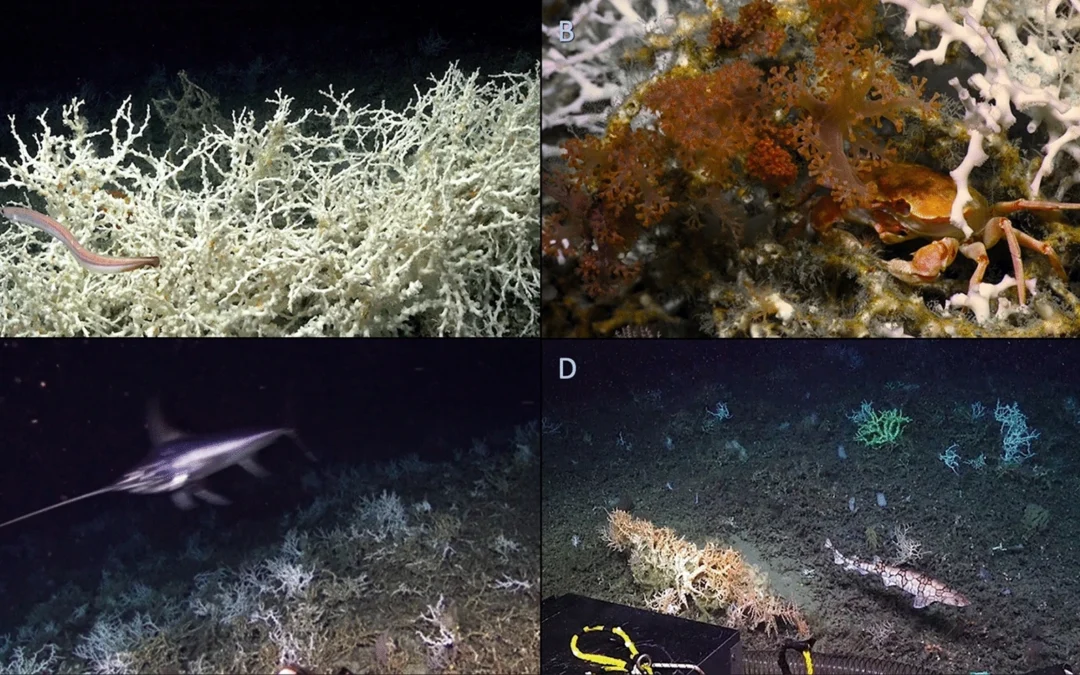
The Lophelia pertusa community at Viosca Knoll (VK826) is the most extensive found to date in the Gulf of Mexico. As part of a multi-disciplinary study, the physical setting of this area was described using benthic landers, CTD transects and remotely operated vehicle observations. The site was broadly characterised into three main habitats: (1) dense coral cover that resembles biogenic reef complexes, (2) areas of sediment, and (3) authigenic carbonate blocks with sparse coral and chemosynthetic communities. The coral communities were dominated by L. pertusa but also contained numerous solitary coral species. Over areas that contained L. pertusa, the environmental conditions recorded were similar to those associated with communities in the north-eastern Atlantic, with temperature (8.5–10.6 °C) and salinity (ca. 35) falling within the known species niche for L. pertusa. However, dissolved oxygen concentrations (2.7–2.8 ml l−1) and density (σΘ, 27.1–27.2 kg m−3) were lower and mass fluxes from sediment trap data appeared much higher (4002–4192 mg m−2 d−1). Yet, this species still appears to thrive in this region, suggesting that L. pertusa may not be as limited by lower dissolved oxygen concentrations as previously thought. The VK826 site experienced sustained eastward water flow of 10–30 cm s−1 over the 5-day measurement period but was also subjected to significant short-term variability in current velocity and direction. In addition, two processes were observed that caused variability in salinity and temperature; the first was consistent with internal waves that caused temperature variations of 0.8 °C over 5–11 h periods. The second was high-frequency variability (20–30 min periods) in temperature recorded only at the ALBEX site. A further pattern observed over the coral habitat was the presence of a 24 h diel vertical migration of zooplankton that may form part of a food chain that eventually reaches the corals. The majority of detailed studies concerning local environmental conditions in L. pertusa habitats have been conducted within the north-eastern Atlantic, limiting most knowledge of the niche of this species to a single part of an ocean basin. Data presented here show that the corals at VK826 are subjected to similar conditions in temperature, salinity, and flow velocity as their counterparts in the north-east Atlantic, although values for dissolved oxygen and density (sigma-theta: σΘ) are different. Our data also highlight novel observations of short-term environmental variability in cold-water coral habitat.

Published in Deep Sea Research vol one 57.

Full Citation

Davies, A.J., Duineveld, G.C.A., van Weering, T.C.E., Mienis, F., Quattrini, A.M., Seim, H.E., Bane, J.M. & Ross, S.W. (2010) “Short-term environmental variability in cold-water coral habitat at Viosca Knoll, Gulf of Mexico.” Deep-sea Research Vol 1. 57(2): 199-212.

Request PDF

To request a PDF of this paper, please enter your email address here:
Tags: , , , , ,