Author Archive

Habitat Suitability for Cold-Water Corals

April 16th, 2011  |  Published in Computers, General ecology, Marine ecology, Publications

The framework-forming coral Lophelia pertusa

Andrew J. Davies and John Guinotte

Cold-water corals are found in all the oceans of the world. Usually below 200 metres, they create structurally complex habitat that gives rise to a unique deep-sea ecosystem in, what otherwise may be a relatively featureless area. Numerous other filter-feeding organisms are found, along with fish that may use the coral as a nursery ground. Yet, we don’t know where many occurrences of cold-water coral are….

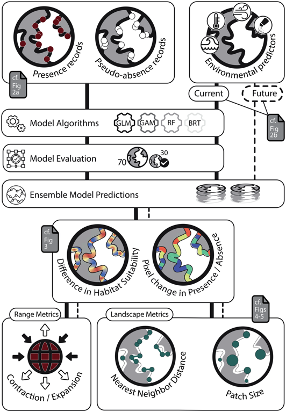
This is where habitat suitability modelling comes in. By using the best available scientific information and powerful statistical tools, we are able to predict, based on the species environmental requirements where they are likely to occur. Mine and John’s work, published in PLoS ONE is an important step towards turning habitat suitability modelling into a viable tool for the protection of vulnerable marine ecosystems in the deep sea. This paper represents several years of work, designing and constructing new approaches to allow us to model coral distributions at high resolution. The outputs speak for themselves, with a 1 km resolution, we may finally be able to say to other researchers, go here, you have a good chance of finding coral in this area. Or, we may be able to say, there is a high probability of coral occurrence here, perhaps we could designate this area closed to bottom contact fishing or other exploitation.

Read the abstract below, or download the PDF from either my site or the PLoS ONE site.

Request PDF

To request a PDF of this paper, please enter your email address here:
Your email address is not stored, it is only used to send an email to you.

Full citation

Davies AJ, Guinotte JM (2011) Global Habitat Suitability for Framework-Forming Cold-Water Corals. PLoS ONE 6(4): e18483. doi:10.1371/journal.pone.0018483

Abstract

Predictive habitat models are increasingly being used by conservationists, researchers and governmental bodies to identify vulnerable ecosystems and species’ distributions in areas that have not been sampled. However, in the deep sea, several limitations have restricted the widespread utilisation of this approach. These range from issues with the accuracy of species presences, the lack of reliable absence data and the limited spatial resolution of environmental factors known or thought to control deep-sea species’ distributions. To address these problems, global habitat suitability models have been generated for five species of framework-forming scleractinian corals by taking the best available data and using a novel approach to generate high resolution maps of seafloor conditions. High-resolution global bathymetry was used to resample gridded data from sources such as World Ocean Atlas to produce continuous 30-arc second (~1 km2) global grids for environmental, chemical and physical data of the world’s oceans. The increased area and resolution of the environmental variables resulted in a greater number of coral presence records being incorporated into habitat models and higher accuracy of model predictions. The most important factors in determining cold-water coral habitat suitability were depth, temperature, aragonite saturation state and salinity. Model outputs indicated the majority of suitable coral habitat is likely to occur on the continental shelves and slopes of the Atlantic, South Pacific and Indian Oceans. The North Pacific has very little suitable scleractinian coral habitat. Numerous small scale features (i.e., seamounts), which have not been sampled or identified as having a high probability of supporting cold-water coral habitat were identified in all ocean basins. Field validation of newly identified areas is needed to determine the accuracy of model results, assess the utility of modelling efforts to identify vulnerable marine ecosystems for inclusion in future marine protected areas and reduce coral bycatch by commercial fisheries.

Tags: , , , , ,

PhD on macroalgal chemical defence at SOS

February 10th, 2011  |  Published in Marine ecology

The School of Ocean Sciences (SOS), Bangor University has two competitive PhD positions available, applicants must choose from one of several projects with academics in the School. This year, my self and Dr Jan Hiddink have the opportunity to present a project entitled:

Trade-offs in macroalgal chemical defences: Battle of the sexes, invaders and consumers.

Figure 1: A. Sargassum muticum, B. Ascophyllum nodosum

Chemical defences consisting of secondary metabolites are found in some macroalgae with their primary function appearing to be as an anti-grazing deterrent (Ragan & Glombitza 1986). This project will investigate the role that phlorotannins play in the ecology of two canopy forming macroalgae, Ascophyllum nodosum and Sargassum muticum. Ascophyllum is a striking example of an important foundation species commonly found on sheltered shores throughout the North Atlantic. In contrast, Sargassum is a Japanese macroalgae that is a highly successful invader of the UK’s rocky shores, it was first observed in the UK on the Isle of Wight in 1973 and has spread rapidly throughout the coastline, reaching Northern Ireland in 1995, south-west Wales in 1997 and Loch Ryan in Scotland in 2004 (Boaden 1995, Eno et al. 1997, Farnham et al. 1973).

Ascophyllum canopies can have a high biomass and influences biodiversity by providing a stable canopy that facilitates understory algae (Jenkins et al. 1999). This species is relatively long lived, with estimated holdfast ages exceeding 50 years (Åberg 1992) and is considered to be well protected from grazers by the secondary metabolite, phlorotannin with typical  concentrations of ca. 5 % of dry weight (Pavia et al. 2003). However, Sargassum has rapid annual growth and comparatively, has lower phlorotannin concentrations of ca. 1-2% (Plouguerné et al. 2006), but has been found to be as high as 8% in certain sites at the height of its reproductive cycle (C. Fendell, MSc).

This proposed project is split into three main themes across several chapters; sexual and reproduction, invasion, and grazers and aims to answer some interesting questions about the ecology of these species.

Chapters 1 and 2, Sexual reproduction and defence: Phlorotannins are energetically costly to produce, so another process must suffer if an individual alga is to develop more in response to an external stressor, but what is sacrificed first, reproduction or growth? To investigate how phlorotannins concentrations are related to sexual reproduction two experimental approaches will be used, firstly, choice/no choice grazing experiments will be used to determine native grazer preference between sexes of Ascophyllum. Secondly, experimental caging in the field will be used to determine if grazer exclusion leads to increased fecundity in Ascophyllum and Sargassum.

Chapter 3, Growth and defence: Previous authors have found higher phlorotannin concentrations in adults of Ascophyllum than in juveniles (Pavia et al. 2003), indicating that juveniles may divert energy to growth as opposed to defence. Sargassum is an exceptionally fast growing alga, it has small perennial section, but the large fronds are annual and appear during spring and summer before breaking up in autumn. Growth will be measured in a range of different sites to determine if patterns similar to those observed in Ascophyllum are present in Sargassum.

Chapters 4, 5 and 6, Grazer palatability and the balance of native/non-native communities: One overlooked area of research for Sargassum is the interaction of this species with native grazer communities on temperate rocky shores. Last year, we found that Sargassum generally has low levels of phlorotannin but under certain circumstances can rapidly produce much greater amounts. If Sargassum is able to produce phlorotannin rapidly, it may be more resistant to grazing pressure than native algae. To determine this, choice/no choice grazing experiments will be conducted with multiple grazers in the laboratory and in the field. Several long-term exclusion and inclusion experiments will be established in the field to determine the temporal interaction of grazers, growth and phlorotannins. Finally, a broad-scale survey throughout the UK coastline will be conducted to determine geographical variability in phlorotannin  concentrations for Sargassum and Ascophyllum.

Training: This project will utilise biochemical analyses and experimentation. The student will be taught how to determine phlorotannin concentration, experimental design, field surveys and analysis. Long-term experiments will be established on local shores, and broad-scale survey extending the British coastline will be undertaken to assess the importance of phlorotannins for native and non-native species.

Application procedure

Applications are invited from suitably qualified students for several NERC Quota award PhD studentships in the School of Ocean Sciences.  You are eligible to apply if you have or expect to receive a 2.1 degree or higher, you are a UK citizen and you have always lived in the UK.  If you have a 2.2 degree, but have also obtained a masters qualification, you are also eligible (see www.nerc.ac.uk/funding/available/postgrad/eligibility.asp).

Interested candidates should send a CV, with the names and addresses of two referees who can comment on their ability and a covering letter, to Andrew Davies (andrew.j.davies @ bangor.ac.uk) by the closing date 31st March 2011.  Candidates should ensure they are eligible to apply for NERC studentship by visiting the NERC web pages.  One candidate for each PhD will be selected by the supervisor and a further short list of candidates compiled.  Candidates will then be invited for interview in late April or early May.   Following an offer of a PhD, successful students will be invited to complete a Bangor University PhD application form. Applicants should NOT complete a Bangor University PhD application form until asked.

The PhD description can be downloaded here: Trade-offs PhD (163).